
Views: 0 Author: Site Editor Publish Time: 2026-09-24 Origin: Site


Frequent film breaks during automated pallet wrapping operations create a compounding drain on facility resources. Every time a roll snaps, packaging lines halt, throughput drops, and operators must manually intervene to rethread the carriage. Beyond the immediate downtime, compromised wrapping cycles lead to wasted material and severe risks to shipping integrity. Isolating the root cause of these continuous breaks presents a technical challenge. Film failure rarely stems from a single isolated defect. It occurs at the intersection of mechanical tension settings, material specifications, environmental warehouse conditions, and the physical profile of the pallet load itself. Operators often guess at solutions, dialing down tension settings or swapping rolls indiscriminately. This only masks the underlying mechanical or material deficiency. We need a systematic, evidence-based diagnostic framework. By analyzing the physical characteristics of the tear and auditing the equipment's delivery system, you can accurately determine the necessary corrective action.
Identify the Break Pattern: The physical characteristics of a film tear (clean cut vs. jagged stretch) immediately indicate whether the fault lies with machine components or film quality.
Match Film to Machinery: Utilizing standard pallet wrapping film on equipment designed for high-speed stretch wrapping with aggressive pre-stretch gears often results in continuous snapping.
Load Profiling is Critical: Sharp corners, uneven stacking, and off-center placement account for a significant percentage of containment failures, requiring specific wrap patterns or high elongation stretch film.
Look Beyond Cost Per Roll: Resolving chronic breaks requires evaluating the total cost of pallet load containment, making the technical expertise of your stretch film supplier a critical decision factor.
Establishing a baseline for successful wrapping requires achieving consistent force-to-load without material failure. Force-to-load is the holding pressure the film exerts on the pallet after the wrapping cycle completes. When your automatic pallet wrapping film snaps before achieving this baseline, stop the machine immediately. Do not clear the web. The physical evidence left on the film web serves as a diagnostic map. It points directly to either mechanical interference or material limitations.
Analyzing the tear pattern provides immediate clues. Clean, straight cuts across the film web almost always indicate mechanical damage. The film is dragging across a sharp edge somewhere along the delivery path. Look for microscopic nicks on the pre-stretch rollers. Check for burrs on the carriage door. Inspect the dancer bars for caught debris. Even a tiny metal shaving lodged in the carriage door hinge can slice the film web cleanly in half during high-speed operation.
V-shaped or highly jagged tears point toward material failure, excessive secondary tension, or a direct puncture from a sharp protrusion on the load itself. When the film stretches beyond its yield point before snapping, the edges appear thinned out and highly distorted. This necking down effect shows the plastic polymers were stretched past their elastic limit.
Tracking the wrinkles offers another diagnostic metric. If the film web develops distinct diagonal wrinkles just before snapping, you likely have roller misalignment within the carriage. Uneven tension distribution across the web causes this. As the film travels through misaligned rollers, one side of the web pulls tighter than the other. This creates localized stress concentrations that eventually tear.
To isolate the primary variable, conduct a step-by-step isolation test:
Remove the pallet from the turntable completely to eliminate load profile variables.
Run a standard wrap cycle with an empty turntable, observing the carriage feed.
Watch the film feeding through the carriage. If it breaks without a load, the issue is entirely mechanical within the carriage or tension settings.
If it does not break, swap the current roll with a roll from a different manufacturing batch or a known good roll.
Run the cycle again with a standard test load. If the new roll runs flawlessly under the exact same machine settings, the original material is defective or incompatible with your equipment's pre-stretch ratio.
Document the tension settings and gear ratios during the test to establish a working baseline.
Equipment malfunctions account for a massive percentage of film breaks. You must understand the mechanical components that dictate film tension and delivery. high-speed stretch wrapping environments place immense stress on both the machinery and the material. Minor mechanical deviations quickly amplify into catastrophic film failures.
The pre-stretch carriage and its internal rollers require rigorous maintenance. Rollers accumulate tackifier resin build-up over thousands of cycles. This sticky residue alters the diameter and surface friction of the rollers. It causes uneven film feed and sudden tension spikes. Operators must inspect the rollers for scoring, gouges, or bearing failures that prevent smooth rotation.
Proper film threading is equally critical. Improper routing through the dancer bars remains a primary cause of immediate snapping upon cycle initiation. Threading the film backward against the intended roller direction will also cause instant failure. Most machines have a threading diagram printed directly on the carriage; operators must follow it precisely.
Tension and force-to-load calibration dictate how the film behaves between the carriage and the pallet. Primary tension occurs inside the carriage. Two rollers spinning at different speeds stretch the film. This is the pre-stretch. Secondary tension is the pulling force applied between the carriage and the rotating load. Setting the secondary tension too high for the film's specific yield strength guarantees continuous breaks. Tension naturally peaks at the corners of the pallet.
Operators must verify the actual pre-stretch ratio of their equipment. Do not rely solely on the manufacturer's manual, as gear wear alters performance over time. To calculate the true pre-stretch, mark a ten-inch section of film with a marker before it enters the carriage. Run the machine and measure the distance between those two marks after the film exits the carriage but before it hits the pallet. If the ten-inch section now measures thirty inches, your machine is pulling a 200% pre-stretch. If your film is only rated for 150%, it will break continuously. This simple field test eliminates guesswork and provides hard data for troubleshooting.
Turntable wear and tear directly impacts film integrity. Worn turntable bearings, misaligned tracks, or degraded drive chains cause jerky, inconsistent rotation. When a heavy pallet stutters or catches during rotation, it creates a violent, instantaneous tension spike. This spike easily exceeds the film's maximum breaking point. Smooth, continuous motion is non-negotiable for automated wrapping.
Sensor, PLC, and programming conflicts frequently masquerade as material failures. Basic operational checks must verify that emergency stops, safety bumpers, or lanyard switches have not been partially tripped. An abrupt carriage halt while the turntable continues to spin will instantly snap the film.
OEM parameter settings require auditing. Specific machine parameters, such as carriage travel limits or wrap cycle functions, might be incorrectly programmed. Common hardware faults include misaligned photo-eyes. If a photo-eye fails to read dark, highly reflective, or irregularly shaped loads, it leads to erratic carriage movements. These movements stretch the film beyond its capacity.
Implement a strict routine maintenance schedule to prevent mechanical failures:
Daily: Visually inspect the carriage door for debris. Wipe down photo-eye sensors with a microfiber cloth. Check the turntable for loose debris that could impede rotation.
Weekly: Inspect the pre-stretch rollers for resin build-up. Clean with an approved industrial solvent if tackiness is detected. Verify the dancer bar moves freely without binding.
Monthly: Lubricate the turntable drive chain. Inspect turntable bearings for wear or flat spots. Run a force-to-load audit using a digital tension scale to ensure calibration remains accurate.
Common Mechanical Failures and Diagnostic Indicators | |||
Mechanical Component | Failure Symptom | Visual Indicator on Film | Corrective Action |
|---|---|---|---|
Pre-Stretch Rollers | Resin build-up or bearing drag | Diagonal wrinkles, inconsistent web width | Clean rollers with approved solvent; replace worn bearings. |
Carriage Door/Path | Burrs, sharp edges, or debris | Clean, straight horizontal cuts across the web | File down burrs; clear debris from dancer bars. |
Turntable Drive | Worn chain or damaged bearings | Snapping at random intervals, jerky rotation | Lubricate drive chain; inspect and replace turntable bearings. |
Photo-Eye Sensor | Failing to detect load height | Carriage over-travels or stops abruptly | Clean sensor lens; adjust sensitivity for dark/reflective loads. |
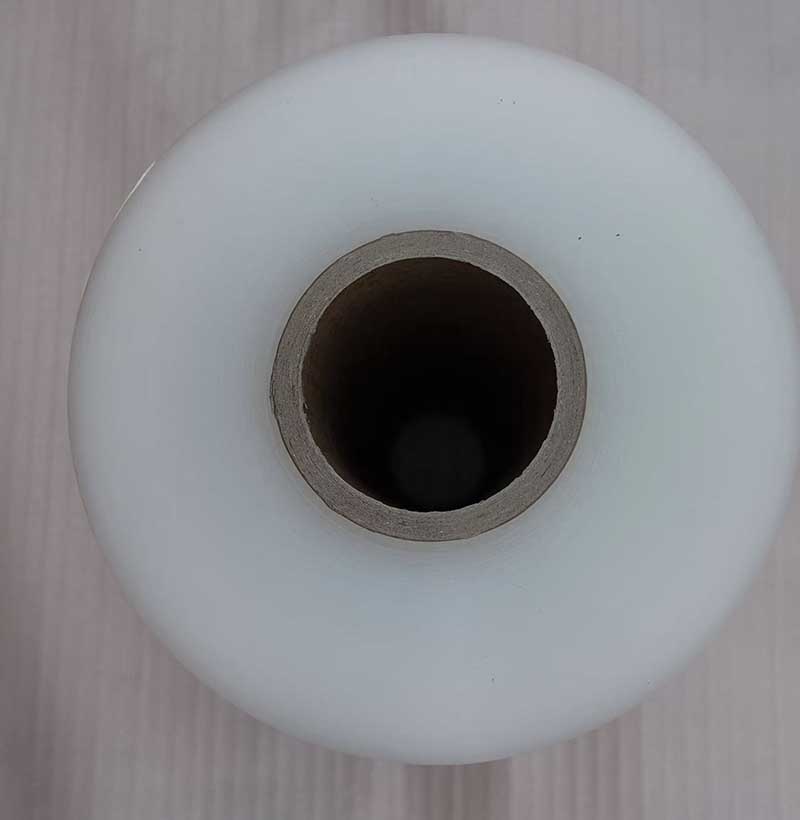
Selecting the correct film architecture for specific operational stresses prevents continuous breakages. Many facilities operate under the false assumption that thicker gauge film inherently prevents breaking. In modern packaging, this is a dangerous misconception. Multi-layer, thinner-gauge engineered films frequently outperform thicker commodity films. They utilize advanced resin blends and superior extrusion techniques. A thick, rigid film may lack the necessary elasticity to survive aggressive pre-stretch gears. It will snap. A thinner, highly engineered film will stretch and conform.
Understanding the role of high elongation stretch film is vital for high-throughput operations. Elongation parameters define how far a film can stretch before structural failure. Standard films might offer a 150% to 200% pre-stretch capability. Modern automated wrappers often feature pre-stretch gears set at 250%, 300%, or even 350%. Running a standard 200% yield film through a 300% gear set guarantees continuous breaks. You must transition to high elongation materials to accommodate aggressive pre-stretch gears without reaching the material's breaking point.
Resin blends dictate puncture resistance and tear propagation. The inclusion of metallocene additives significantly improves a film's ability to resist tear propagation. If a sharp corner punctures a standard film, the tear will immediately zip across the entire web. Metallocene-enhanced films contain the puncture. They prevent it from spreading and causing a complete web failure.
Evaluating cast versus blown machine stretch film characteristics is necessary. Blown film generally offers superior puncture resistance and a higher degree of memory. This makes it ideal for abrasive loads. It does produce more noise during unwinding. Cast film provides exceptional clarity, quieter operation, and consistent gauge control. It excels in uniform load applications.
Cast vs. Blown Machine Stretch Film Characteristics | ||
Property | Cast Stretch Film | Blown Stretch Film |
|---|---|---|
Manufacturing Process | Extruded flat over cooling rollers | Extruded circularly and inflated with air |
Puncture Resistance | Moderate (suitable for A and B loads) | High (ideal for sharp C loads) |
Clarity and Noise | High clarity, very quiet unwind | Hazy appearance, loud unwind noise |
Tear Propagation | Tears can spread if punctured | Excellent resistance to tear spreading |
Gauge Consistency | Highly consistent across the web | Slight variations due to inflation process |
Environmental impacts on film performance require attention. Warehouse temperature fluctuations drastically alter the physical properties of plastic packaging. Cold environments, such as refrigerated storage or unheated winter warehouses, cause standard films to become brittle. This significantly reduces their elasticity and makes them highly prone to snapping. Excessive heat can alter the tackifier additives. This increases cling to unmanageable levels and causes the film to over-extend its yield strength. The result is a loss of containment force and eventual tearing.
The physical characteristics of the product being wrapped dictate the success or failure of the wrapping cycle. Even perfectly calibrated machinery and premium film will fail if the load profile presents insurmountable physical hazards. Achieving optimal pallet load containment requires matching the wrap pattern and film type to the specific geometry of the stacked product.
Classifying load profiles into A, B, and C categories helps standardize the wrapping approach.
A-Loads represent the ideal scenario. They consist of uniform, perfectly stacked boxes with no protrusions. They present a low risk of puncture or tension spikes.
B-Loads feature irregular stacking patterns, slight overhangs, or minor puncture hazards. They represent a moderate risk that requires careful tension management.
C-Loads are highly irregular. They feature sharp metal corners, heavy protrusions, and deep voids. These high-risk loads are the primary cause of load-induced film breaks.
Mitigating uneven loads and misalignment requires understanding the physics of turntable rotation. Off-center loads create an eccentric rotation path. As the protruding side of the pallet swings away from the carriage, it rapidly accelerates the demand for film feed. This creates a massive tension spike. As the load rotates back toward the carriage, the tension abruptly drops. This erratic pulsing snaps film instantly.
Implementing mitigation strategies is non-negotiable for difficult profiles. Utilize heavy-duty corner boards to protect the film from sharp box edges and metal protrusions. Adjust wrap patterns. Utilize a roping function where the film is bunched into a strong cable. This helps secure heavy loads to the wooden pallet base without tearing the wider web. Ensure precise, centered pallet alignment on the turntable before initiating the cycle. This eliminates eccentric rotation. Optimize turntable speed. Slow it down for highly irregular C-Loads. This gives the carriage dancer bars sufficient time to respond to changing tension demands.
Load Profile Classification and Mitigation Strategies | |||
Load Profile | Characteristics | Risk Level | Recommended Mitigation Strategy |
|---|---|---|---|
A-Load | Uniform, flush with pallet, no sharp edges | Low | Standard cast film, high pre-stretch ratio, standard turntable speed. |
B-Load | Slight overhang, irregular stacking, minor gaps | Moderate | Adjust secondary tension, use high elongation film, apply top sheets if needed. |
C-Load | Sharp metal corners, heavy protrusions, deep voids | High | Use blown film or metallocene blends, apply corner boards, reduce turntable speed, utilize roping. |
Transitioning from daily troubleshooting to strategic procurement prevents future downtime. Choosing a partner capable of diagnosing mechanical and material intersections ensures long-term operational stability. A reliable stretch film supplier acts as a technical consultant rather than a mere vendor of consumables.
Technical support and on-site auditing capabilities separate premium suppliers from commodity brokers. Evaluate suppliers based on their ability to perform rigorous, data-driven facility audits. This includes conducting cut-and-weigh tests to determine exact material usage per pallet. They should perform force-to-load audits to ensure the film exerts adequate containment pressure without risking failure. Suppliers should possess the mechanical expertise to calibrate carriage tension settings. This ensures the machinery and the film operate in perfect synchronization.
Consistency and quality control at the manufacturing level directly impact daily operations. Assess the supplier's manufacturing tolerances to ensure roll-to-roll consistency. Poor gauge control during the extrusion process results in thin bands running through the film web. These thin spots act as weak links. They cause sudden, unpredictable spikes in breakages even when machine settings remain untouched. A supplier utilizing advanced extrusion technology with strict quality assurance protocols guarantees that every roll performs identically to the last. This eliminates a major variable in the troubleshooting process.
When evaluating a new supplier, request a trial run on your most difficult C-Load. Monitor the film's performance through the pre-stretch carriage and measure the final containment force. A competent supplier will adjust the machine settings during the trial to optimize the film's yield without compromising load stability. They will provide a detailed report outlining the exact tension settings, gear ratios, and wrap patterns required to maintain continuous operation.
Take the following actions to eliminate continuous film breaks on your packaging line:
Schedule a comprehensive containment audit with a qualified technician to establish accurate force-to-load baseline metrics for your specific equipment.
Inspect and thoroughly clean all pre-stretch carriage rollers using approved industrial solvents to remove resin build-up and verify bearing integrity.
Audit your current film's maximum elongation rating to ensure it matches or exceeds the pre-stretch gear ratio physically installed on your wrapping machinery.
Implement strict load-centering protocols and utilize heavy-duty corner boards for all C-profile loads before initiating the wrap cycle.
A: Corners represent the furthest point of rotation from the film carriage, creating the highest peak in secondary tension. If the secondary tension is set too high, or if the film lacks sufficient elongation and puncture resistance, the sudden force spike at the corner will exceed the material's yield strength, causing it to snap.
A: The ideal percentage depends entirely on your machine's gear ratio and the film's engineered capabilities. Standard machines typically operate between 200% and 250% pre-stretch. High-speed, high-performance wrappers can push pre-stretch to 300% or more, which strictly requires a high elongation film designed specifically for those extreme ratios.
A: No. Hand stretch wrap is engineered for manual application, typically featuring a much lower stretch yield (around 150%) and a different core size. Running hand film through a machine's pre-stretch carriage will result in immediate and continuous snapping, as the gears will stretch the material far beyond its structural capacity.
A: Rollers should be visually inspected daily and thoroughly cleaned at least once a month, or more frequently in high-volume operations. Tackifier resin from the film builds up on the rollers over time, altering their diameter and surface friction. This build-up causes uneven film feeding, diagonal wrinkling, and eventual tearing.
A: Blown film is manufactured through a circular extrusion process, giving it superior bi-directional tear resistance and higher puncture strength, making it highly resilient against sharp C-loads. Cast film is extruded flat, offering excellent clarity, quiet unwinding, and highly consistent gauge control, which prevents breakages caused by thin spots in uniform wrapping applications.
A: Cold temperatures cause the plastic polymers to contract and become brittle, drastically reducing the film's elasticity and making it highly susceptible to snapping under normal tension. Excessive heat softens the film, increasing its tackiness and causing it to over-stretch, which compromises the final containment force holding the load together.


