
Views: 0 Author: Site Editor Publish Time: 2026-09-29 Origin: Site


High-volume logistics operations often treat stretch film as a generic consumable. This mindset leads to invisible budget bleed and preventable transit damage. Procurement teams buy based on roll price. Warehouse managers struggle with inconsistent load stability and unpredictable film depletion rates. Guessing the required film volume results in either critical under-wrapping or chronic over-wrapping. Under-wrapping risks severe product loss. Over-wrapping wastes massive amounts of material over time.
Moving from estimation to exact calculation requires auditing load profiles, application methods, and film specifications. This guide provides the technical framework to determine exactly how much film is required per load. You will learn how to standardize material usage, calculate exact pallets per roll, and optimize load containment for safer transit.
Metric Shift: The only accurate metric for evaluating packaging efficiency is the true cost of stretch film per pallet—and ultimately, the "cost per accepted pallet"—not the price per roll or price per pound.
Application Dictates Yield: Transitioning from manual wrapping to automated systems with high pre-stretch capabilities can reduce film consumption per pallet by up to 60%, with ROI typically realized at a threshold of just 30 pallets per shift.
Gauge vs. Performance: Thicker film does not automatically guarantee better containment; modern multi-layer engineered films allow for "down-gauging" without sacrificing holding force.
The Calculation Variables: Accurate film usage estimation requires precise data on load footprint, wrap height, overlap percentage, top/bottom wrap counts, and film density.
Defining your operational goal establishes the foundation for packaging efficiency. The primary objective is achieving maximum load containment force using the absolute minimum necessary weight of plastic. The load must survive the entire transit lifecycle, from the warehouse floor to the receiving dock. Evaluating success requires looking beyond the purchasing invoice and examining the physical application of the material on the floor.
Evaluating procurement contracts based solely on roll cost completely obscures true usage. A cheaper roll of film often features poor stretch memory and inferior puncture resistance. When operators or machines apply this lower-grade film, they must use significantly more revolutions to achieve the required containment force. You consume that roll twice as fast. This false economy increases your material expenditure per load, negating any upfront savings on the invoice.
Before attempting any optimization, you must establish a baseline "ounces per pallet" metric. This requires a physical audit of your current wrapping process. You cannot improve what you do not accurately measure. Follow this standard field procedure to determine your current consumption:
Select a representative wrapped load from your staging area that reflects your average shipping profile.
Place an empty trash bag on a highly calibrated industrial gram scale and tare the scale to zero.
Use a safety hook knife to slice the film vertically down the side of the pallet, ensuring you do not cut into the product packaging.
Peel the film off the load entirely. Remove any paper labels, packing tape, or corner boards attached to the plastic.
Compress the removed film into a tight ball, place it into the tared trash bag, and record the exact weight in ounces or grams.
True baseline metrics must factor in the rate of transit damage. Saving material weight means nothing if the load shifts during transit and is rejected at the receiving dock. The "cost per accepted pallet" incorporates the material expenditure, the labor required for application, and the amortized loss of damaged goods. A highly engineered film might require a higher initial investment, but if it eliminates load rejection, the true expenditure per accepted pallet drops dramatically.
Several physical variables dictate exactly how much plastic you need to secure a load. You must analyze load geometry, material thickness, and roll dimensions to build an accurate usage model.
Load geometry directly impacts film consumption. Sharp corners, irregular shapes, and heavy components require different wrapping strategies than uniform boxes. Industry standards categorize loads into three distinct profiles, each demanding a specific approach to containment.
"A" Profile Loads: These are perfectly uniform loads with no sharp edges. The boxes align flush with the pallet edges. These loads present the lowest risk of film puncture and require the least amount of containment force. You can utilize thinner films and fewer revolutions.
"B" Profile Loads: These loads are slightly irregular. Boxes may be offset, creating minor puncture risks. Order picking pallets often fall into this category. They require a slightly heavier gauge or a higher overlap percentage to maintain stability across uneven surfaces.
"C" Profile Loads: These are highly irregular loads with sharp corners, protruding parts, or extreme weight variations. Heavy machinery parts or oddly shaped metal components are typical examples. These require thick films, specialized roping techniques, and high containment force to prevent catastrophic failure.
Understanding stretch film thickness dictates your yield calculations. Thickness typically ranges from ultra-thin 24 gauge up to heavy-duty 130 gauge. Historically, warehouses relied on standard 80-gauge film for almost all applications. Modern manufacturing techniques have changed this dynamic entirely.
Multi-layer cast films now offer exceptional performance at much lower gauges. You can often replace a traditional 80-gauge film with a high-performance 36-gauge to 50-gauge film. This "down-gauging" process reduces the weight of plastic applied to the load while maintaining the puncture resistance and stretch capacity. Thinner films yield more feet per roll, directly driving down the material expenditure per load.
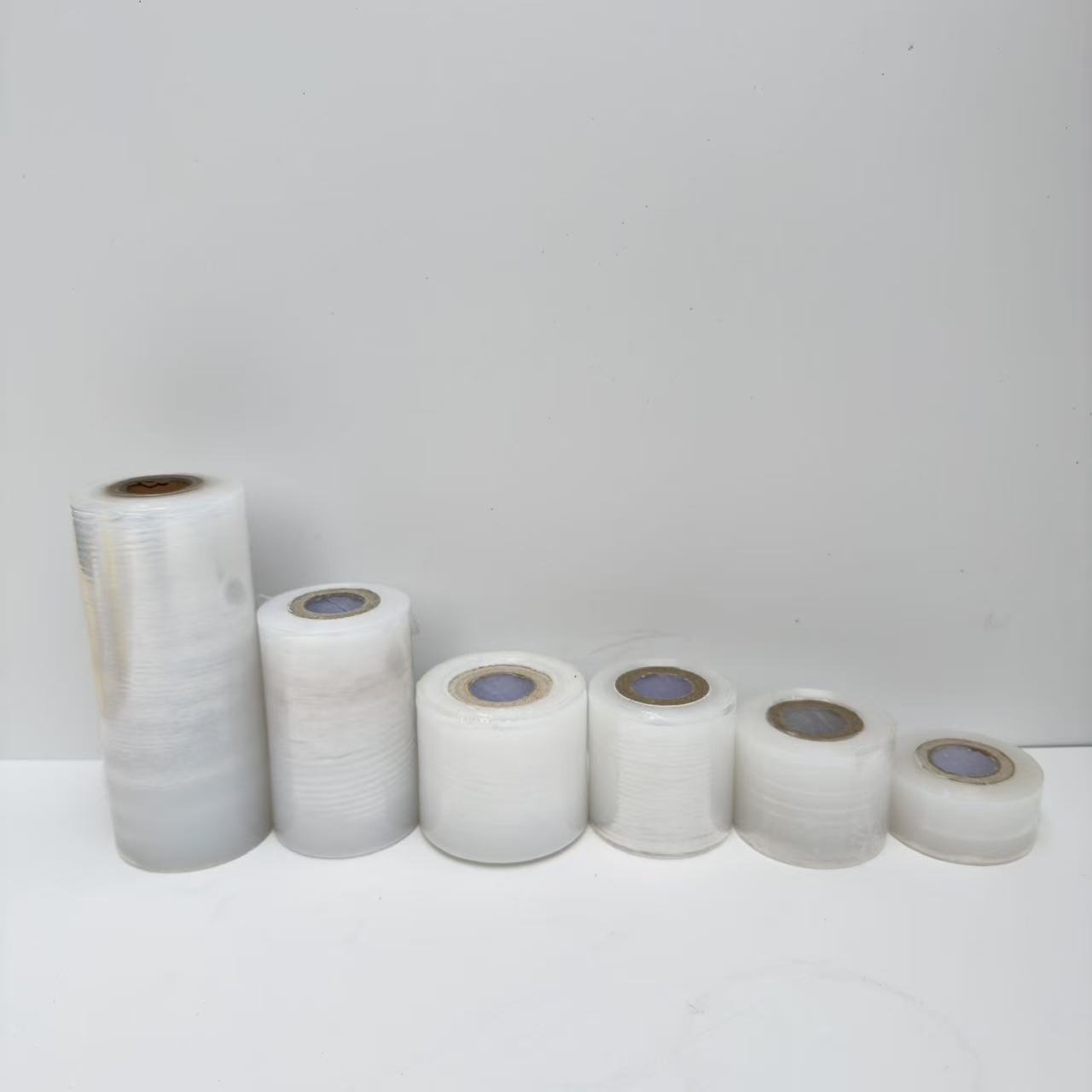
Standard widths vary significantly across the packaging spectrum. You will find everything from 3-inch banding film used for bundling small pipes to 40-inch wide web rolls designed for specialized automated equipment. Selecting the right stretch film roll size impacts both application speed and material overlap.
Hand rolls typically measure 18 inches wide by 1,500 feet long and come packaged four rolls to a case. Machine rolls are much larger, typically 20 inches wide by 5,000 feet long, packaged as a single roll per case. Wider rolls reduce the total number of revolutions required to cover the height of the load. Wider webs can complicate overlap calculations and require precise machine tension settings to prevent the film from tearing at the corners.
Load Profile and Wrap Strategy Matrix | |||
Load Profile | Characteristics | Recommended Gauge | Target Containment Force |
|---|---|---|---|
A-Profile | Flush edges, uniform weight, no protrusions | 35 - 45 Gauge | 10 - 15 lbs |
B-Profile | Slightly irregular, mixed SKU pallets, minor gaps | 50 - 65 Gauge | 15 - 22 lbs |
C-Profile | Sharp corners, heavy machinery, extreme irregularity | 70 - 90+ Gauge | 25 - 35+ lbs |
The method of application fundamentally changes the volume of material consumed. Comparing manual application against automated wrapping systems reveals massive disparities in efficiency, yield, and overall load security.
Human operators face strict physical limitations. When applying hand stretch wrap, workers experience fatigue, leading to inconsistent tension from the bottom of the load to the top. A worker might wrap the base tightly but apply loose revolutions near the top as their arms tire. Walking backward in circles around a pallet also creates safety hazards on a busy shipping dock.
Manual wrapping rarely achieves more than 10% to 20% stretch. The film is applied almost at its original manufactured length. Because the material is not stretched to its full potential, you leave unutilized yield on the load. This results in a much higher film weight per pallet and highly inconsistent holding force, increasing the risk of transit damage.
Automated wrappers equipped with powered pre-stretch carriages completely change the consumption equation. When using machine stretch film, the equipment mechanically elongates the plastic before it ever touches the load.
The mechanics of pre-stretch involve threading the film between two rubberized rollers inside the carriage. The secondary roller spins faster than the primary roller, stretching the film by a specific percentage. Modern carriages can achieve pre-stretch levels of 200% to 300%. One foot of film off the roll becomes three or four feet of film applied to the load. This mechanical advantage drastically reduces the total weight of plastic required to secure the pallet.
Many facilities hesitate to invest in automated wrappers due to upfront capital expenditures. The material savings quickly justify the equipment investment. The volume threshold for automation is surprisingly low, typically sitting around just 30 pallets per shift.
Consider the annualized savings. If a powered pre-stretch carriage shaves just 48 grams of plastic off every single pallet, a high-volume facility processing hundreds of loads daily will save nearly a metric tonne of film annually. The reduction in material purchasing directly funds the equipment ROI, often within the first twelve to eighteen months of operation.
Determining your exact stretch film per pallet is a strict mathematical exercise. By following this step-by-step methodology, you can calculate exact usage, estimate film turns, and accurately forecast your procurement needs.
First, calculate the load girth. The formula is (2 x Length) + (2 x Width). For a standard 40x48 inch pallet, the girth is 176 inches. Next, measure the total wrap height. You must factor in the standard 2-inch to 4-inch pallet overlap at the bottom to lock the load to the wooden base. If your boxes stack 60 inches high, your total wrap height is 64 inches. Multiply the girth by the total wrap height to determine the baseline wrapped area.
A single layer of film is never enough. You must account for standard wrap patterns. A typical pattern includes 3 bottom wraps to secure the base, 2 top wraps to lock the upper tiers, and a continuous spiral wrap up and down the load. The carriage ascent and descent typically utilize a 20% to 30% overlap. If you use a 20-inch film with a 25% overlap, your effective wrap width is 15 inches. Dividing your 64-inch wrap height by 15 inches gives you roughly 4.2 revolutions for the ascent. Add the top and bottom wraps to find your total revolutions.
Once you have the total required wrapped length, you must factor in the machine's capabilities. Divide the required wrapped length by the machine's pre-stretch percentage. If your wrap pattern requires 1,000 feet of stretched film on the load, and your carriage operates at 250% pre-stretch, you only need to supply roughly 285 feet of unstretched film from the roll. This calculation isolates the exact length of material consumed per cycle.
To find the financial impact, convert the supplied film length into weight. Use the specific density approximation of polyethylene film, which is typically around 0.92 g/cm³. Calculate the volume of the unstretched film consumed, convert it to weight in kilograms, and multiply that figure by your contracted material rate. This provides the exact material expenditure per pallet.
Divide the total usable length of the stretch film roll by the unstretched supplied film length required per pallet. If you have a 5,000-foot roll and your load requires 285 feet of unstretched film, a single roll will secure exactly 17.5 loads. This metric allows warehouse managers to predict roll changeovers and optimize operator workflows.
Optimization is an ongoing process of balancing material reduction with load security. Upgrading your warehouse pallet packaging strategy requires analyzing conceptual trade-offs and testing new methodologies on the floor.
Right-gauging is the systematic process of testing thinner, higher-performance pallet wrapping film to reduce material usage without compromising load integrity. It involves stepping down from a heavy gauge to a lighter gauge while simultaneously monitoring the containment force. The goal is to find the exact intersection where material weight is minimized, but the load remains perfectly stable under transit stress.
Not all loads are created equal. You must adjust carriage speed, tension, and overlap based on specific load risks. Specialized use cases require tailored settings. Beverage pallets containing canned or bottled goods are extremely dense and prone to shifting. They require exceptionally high containment force. Optimizing these loads involves increasing the bottom wrap count, slowing the carriage ascent to increase overlap, and utilizing a heavy-duty film to prevent catastrophic load failure during sudden braking in transit.
Reducing film weight per pallet is an environmental necessity. Optimizing your wrap patterns aligns directly with corporate sustainability goals by drastically reducing plastic waste. Many jurisdictions are implementing strict plastic tax liabilities based on total tonnage consumed. Slashing your per-pallet film weight directly reduces your exposure to these compliance burdens.
Machine Wrapper Settings Optimization Guide | ||
Setting Parameter | Adjustment Effect | Ideal Application |
|---|---|---|
Carriage Ascent Speed | Controls the overlap percentage of the film web. | Slow down for heavy loads requiring dense film layering. |
Turntable RPM | Dictates the speed of application and centrifugal force. | Decrease RPM for unstable, top-heavy loads to prevent tipping. |
Secondary Roller Tension | Adjusts the post-stretch tension applied directly to the load. | Increase tension for C-profile loads to lock sharp corners tightly. |
Bottom Wrap Count | Secures the product to the wooden pallet base. | Increase to 4-5 wraps for heavy beverage or industrial loads. |
Transitioning to a highly optimized wrapping process introduces specific operational risks. Pushing materials and machines to their limits requires strict quality control protocols to prevent transit failures.
Every film has a maximum elastic limit. Pushing the film beyond this threshold causes severe micro-tears in the web. While the film might look intact on the load, its structural integrity is compromised. Over-stretching leads to catastrophic web breaks during the wrapping cycle, halting production. It can cause the film to snap during transit, leading to immediate load shifting and product destruction.
Procurement teams must avoid purchasing low-quality films manufactured with cheap resin blends. These inferior films suffer from extremely poor tear propagation resistance. If a minor puncture occurs during wrapping, the tear will instantly propagate across the entire web, causing a blowout. A single web break during a machine cycle requires the operator to stop, tie off the film, and restart the machine. The labor cost of this downtime instantly negates any perceived savings from buying cheaper film.
To mitigate these risks, warehouse managers must implement routine auditing procedures. Conduct weekly cut-and-weigh audits to ensure the calculated film usage matches real-world performance. Mandate strict containment force testing using a pull plate. A pull plate measures the exact pounds of force exerted by the film at the top, middle, and bottom of the pallet. Insert the plate behind the film web, pull it outward by four inches, and read the scale. This ensures that wrapper settings remain perfectly calibrated and the load is genuinely secure.
Conduct a baseline cut-and-weigh audit on your highest-volume pallet profile today to establish your current material expenditure.
Measure the containment force at the top, middle, and bottom of your loads using a pull plate to verify load security.
Recalibrate your machine pre-stretch gears and carriage ascent speed to maximize the yield of your current film.
Test a lighter gauge, high-performance film on a single wrapping line to measure potential material reduction without sacrificing stability.
A: The exact number depends on the roll length, load girth, wrap height, and machine pre-stretch percentage. A standard 5,000-foot machine roll running at 200% pre-stretch can typically secure 15 to 25 standard pallets, whereas a 1,500-foot hand roll might only wrap 3 to 5 pallets.
A: No. Modern multi-layer cast films offer superior puncture resistance and containment force at lower gauges. A highly engineered 50-gauge film applied with proper tension will secure a load much better than a low-quality 80-gauge film applied loosely.
A: Industry standard dictates a 20% to 30% overlap as the carriage ascends and descends the load. You also need a 2-inch to 4-inch overlap at the very bottom to securely lock the product tiers to the wooden pallet base.
A: Web breaks usually occur due to over-stretching beyond the film's elastic limit, sharp corners on the load, or using low-quality resin films with poor tear propagation resistance. Check your carriage tension settings and inspect the load for protruding edges.
A: You measure containment force using a specialized tool called a pull plate. Insert the plate behind the film web and pull outward until the scale registers the resistance. Measure at the top, middle, and bottom of the load to ensure uniform tension.
A: Yes, if you process more than 30 pallets per shift. Machine wrappers utilize powered pre-stretch, which elongates the film by up to 300%. This drastically reduces material consumption, eliminates operator fatigue, and guarantees consistent containment force.


