
Views: 0 Author: Site Editor Publish Time: 2026-02-13 Origin: Site


In the fast-paced world of logistics and manufacturing, the terms "shrink wrap" and "stretch wrap" are frequently used interchangeably. This linguistic confusion often migrates into procurement orders, leading to significant operational inefficiencies. While both materials look like clear plastic on the roll, mistaking one for the other can result in catastrophic load failures during transit, expensive freight damage claims, or poor retail presentation that hurts brand image.
The fundamental distinction lies in how the material secures the product: one uses Heat, while the other relies on Tension. Understanding this mechanism is not just a matter of semantics; it dictates the equipment you buy, the energy you consume, and the safety of your shipments.
This article provides a technical and commercial comparison between these two essential packaging materials. We will explore their molecular properties, analyze equipment costs, and define specific use cases for "primary" versus "secondary" packaging. By the end, you will have the knowledge to select the right film for your specific application, ensuring both cost-efficiency and load security.
Mechanism: Shrink wrap requires a heat source to tighten; stretch film relies on elastic memory and tension.
Primary Application: Shrink is for individual product aesthetics and protection (retail); stretch is for palletizing and load containment (logistics).
Cost Driver: Stretch film generally offers a lower Total Cost of Ownership (TCO) for bulk transport due to lower energy costs (no heat tunnels required).
Material Science: Shrink is typically Polyolefin or PVC; Stretch is primarily LLDPE (Linear Low-Density Polyethylene).
To make the right purchasing decision, you must first understand the physics behind how these films operate. While they may appear identical to the naked eye, their polymer chains behave differently when applied to a load.
Shrink Wrap (Heat-Activated): Shrink film is designed to change its physical state when exposed to thermal energy. You apply the film loosely around an item—whether it is a frozen pizza or a bundle of water bottles—and seal it. When the package passes through a heat tunnel or is exposed to a heat gun (typically around 300°F), the polymer chains contract. This creates a rigid, durable seal that conforms perfectly to the shape of the product.
Stretch Wrap (Elastic Memory): In contrast, stretch film relies on elasticity. Think of it as a heavy-duty rubber band. During application, the film is mechanically stretched—sometimes up to 300% of its original length. Once applied to the load, the film attempts to return to its original, unstretched state. This constant "elastic memory" exerts a compressive force on the load, holding boxes tightly together on a pallet. This force is technically referred to as "load containment."
If you are standing on a warehouse floor and need to identify a roll of film without a label, you can rely on a simple sensory test:
Shrink Wrap: It feels rigid, crinkly, and smooth. It typically has no adhesive properties and will slide against itself until heated and sealed. It feels similar to the cellophane used on gift baskets.
Stretch Wrap: It feels tacky, pliable, and rubbery. When you pull it, it elongates significantly before breaking. The layers cling to each other without heat or glue, thanks to tackifiers added during manufacturing.
A helpful heuristic for distinguishing these materials is their place in the packaging hierarchy:
Primary Packaging (Shrink): This touches the consumer unit. Examples include the plastic sealing a board game, the wrap around a cucumber, or the box of a new smartphone. It focuses on aesthetics, hygiene, and tamper evidence.
Secondary/Tertiary Packaging (Stretch): This secures groups of products for transport. Its primary job is structural integrity. It secures 50 boxes of smartphones to a wooden pallet so a forklift can move them safely.
Stretch film is the backbone of modern logistics. Without it, the global supply chain would struggle to move palletized goods efficiently. The effectiveness of this material comes from its specific chemical composition and manufacturing processes.
Most industrial stretch wrap is made from Linear Low-Density Polyethylene (LLDPE). This polymer structure gives the film its two most critical characteristics: high elongation (stretch) and high tensile strength. In a logistics environment, puncture resistance is vital. Pallets often have sharp corners or protruding nails; LLDPE allows the film to stretch around these hazards without tearing, preventing the load from spilling during transit.
Not all stretch films are created equal. Different formulations solve specific warehouse problems:
Cast vs. Blown: Cast film is extruded onto a cooling roller, resulting in high clarity and quiet application. Blown film is extruded vertically and air-cooled, creating a tougher film with superior puncture resistance, though it is louder to apply and hazier.
Pre-stretched Film: Traditional film requires the user (or machine) to stretch it to get value. Pre-stretched film is elongated during the manufacturing process. This means a warehouse worker applies it with less physical effort, reducing fatigue and ensuring consistent load tension while minimizing waste.
Black Stretch Film: Security is a major concern for high-value shipments like electronics. Using black stretch film conceals the contents of the pallet, reducing the risk of pilferage. Additionally, opaque black films often contain UV inhibitors, protecting goods from sun damage when stored outdoors.
Protective Applications: It is important to distinguish standard pallet wrap from stretch film protective film designed for surfaces. While pallet wrap holds boxes together, surface protective films use specific adhesives to protect appliances, windows, or automotive parts from scratches during assembly and shipping.
The method of application significantly impacts your material usage and load stability.
| Equipment Type | Throughput Volume | Cost Range (Est.) | Key Benefit |
|---|---|---|---|
| Manual Hand Dispenser | Low (< 10 pallets/day) | $50 – $100 | Low entry cost; portable. |
| Turntable Wrapper | Medium (10–50 pallets/day) | $3,000 – $8,000 | Consistent tension; reduces labor injury. |
| Rotary Arm Wrapper | High (> 50 pallets/day) | $15,000+ | Wraps heavy/unstable loads that cannot spin. |
The "Yield" Factor: Modern semi-automatic machines use pre-stretch carriages. These rollers stretch the film by 200% to 300% before it even touches the pallet. This means 1 foot of film on the roll becomes 3 feet of film on the load, drastically lowering the cost per pallet compared to hand wrapping.
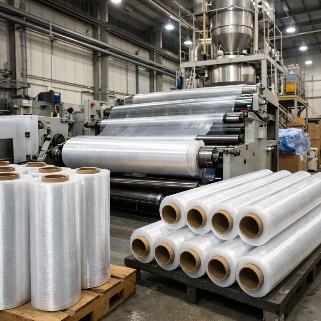
Shrink wrap focuses on presentation and preservation. While less common for heavy pallet containment, it dominates the retail packaging space due to its ability to form a "second skin" around products.
Shrink films are formulated from different polymers depending on the application:
Polyolefin (POF): This is the current industry standard for retail. It is food-safe, extremely clear, and durable. If you see a multi-pack of energy drinks or a shrink-wrapped book, it is likely Polyolefin.
PVC (Polyvinyl Chloride): Once the dominant material, PVC has fallen out of favor. It is brittle in cold conditions and, more critically, releases hazardous chloride gas when heated. This requires expensive ventilation systems to protect workers, making it less attractive for modern operations.
PE (Polyethylene): This is a thicker, heavy-gauge shrink film used for "bundling." It is often seen wrapping 24-packs of water bottles. It provides structural integrity for heavier single-units but lacks the high clarity of Polyolefin.
Implementing shrink packaging requires more than just the film; it requires thermal management.
For low-volume operations, a handheld heat gun can suffice, but this is labor-intensive and results in inconsistent shrinking. High-volume manufacturing lines utilize L-Bar Sealers (to cut and seal the film around the product) followed by Heat Tunnels (conveyor belts running through ovens).
Constraint: You must assess product sensitivity. You cannot use shrink wrap for heat-sensitive items like premium chocolates, certain pharmaceuticals, or delicate electronics, as the tunnel temperatures can degrade or melt the product inside.
Beyond protection, shrink wrap adds commercial value. It provides a glossy finish that enhances colors on retail shelves. Furthermore, it offers tamper evidence. If the seal on a medicine bottle or food container is broken, the consumer knows immediately—a safety feature stretch film cannot provide.
When procurement managers decide between these technologies, they must look beyond the price per roll. You must calculate the Total Cost of Ownership (TCO) and functional suitability.
The following breakdown highlights the functional differences that drive decision-making:
| Feature | Shrink Wrap | Stretch Film |
|---|---|---|
| Protection Level | Sealed / Waterproof / Air-tight | Dust & Moisture Resistant (Open top) |
| Load Stability | Low (unless heavy bundling film) | High (Pallet integrity) |
| Energy Consumption | High (Heat tunnels) | Low (Motorized rotation only) |
| Ventilation | Required (especially for PVC) | Not required |
Consumables: Stretch film generally wins on operational costs for bulk loads. Because high-performance equipment can stretch the film significantly, the amount of resin used per pallet is minimized. Shrink film shrinks but does not elongate, meaning the surface area of the film you buy is roughly the surface area you use.
Capital Expenditure (CapEx):
Entry-level stretch wrappers can be purchased for $3,000 to $5,000. While basic, they function immediately. Conversely, a production-speed shrink line involves an L-Bar sealer and a heat tunnel, often pushing entry costs above $8,000 to $20,000 depending on size. Furthermore, the energy bill for keeping a heat tunnel at 300°F all day is a recurring operational expense that stretch wrappers do not incur.
Choosing the wrong method carries risks:
Shrink Risks: If the tunnel is too hot, you risk damaging the product or starting a fire. If ventilation is poor, you risk employee health issues.
Stretch Risks: The most common issue is "neck-down," where the film narrows as it is stretched, covering less surface area. Additionally, if the tension is set too high on "soft" loads (like empty PET bottles or tissue boxes), the elastic force can crush the boxes, destroying the product before it leaves the warehouse.
Sometimes, neither standard shrink nor standard stretch film fits the bill. Industrial applications often require specialized hybrid technologies.
For high-volume industrial environments, Stretch Hood technology offers the best of both worlds. A machine cuts a tube of film, stretches it mechanically (without heat), and pulls it over the pallet.
The benefit is significant: it provides the waterproof, 5-sided protection of shrink wrap but utilizes the elastic energy efficiency of stretch film. This is increasingly popular for building materials like cement or bricks that require outdoor storage but cannot bear the energy cost of heat shrinking.
Standard films can trap moisture, which is disastrous for organic products. If you are shipping warm baked goods, fresh produce, or lumber that needs to cure, condensation inside the wrap causes mold and rust. Vented stretch films have die-cut holes that allow airflow while maintaining load containment, solving the moisture problem.
For specialized applications, buying off-the-shelf from a general distributor may not yield the best results. Working directly with a dedicated stretch film manufacturer allows you to access custom formulations. You can request specific additives, such as high-slip agents for easier loading or reinforced UV stabilizers for long-term outdoor storage. Manufacturers can also adjust the "cling" levels—one-sided cling is often preferred to prevent pallets from sticking together during truck transit.
The choice between stretch film and shrink wrap is rarely a toss-up; the application usually dictates the solution. However, understanding the nuances ensures you optimize for cost and safety.
Choose Shrink Wrap if: You need retail presentation, tamper evidence, or air-tight sealing for individual items. It is the champion of shelf appeal and small-format bundling.
Choose Stretch Wrap if: You are palletizing goods for transport, need to minimize energy costs, or require high load containment to prevent freight damage. It is the champion of logistics and bulk transport.
Final Tip: Do not just buy film based on the price per roll. A cheap roll of stretch film that breaks constantly or requires five wraps to do the job of two is a false economy. Always calculate the "cost per load"—taking into account film yield, labor time, and waste—to understand the true efficiency of your packaging strategy.
A: No. Applying heat to stretch film will cause it to melt, degrade, and lose its structural integrity. It is not designed to shrink. If you need the film to tighten, you must apply mechanical tension (stretch it) during the application process.
A: Standard stretch film is water-resistant, not waterproof. Because it is applied in spiral layers, water can seep between the layers or enter through the open top of the pallet. For full waterproofing, you must use a top sheet or switch to Stretch Hood technology.
A: Yes, both are typically made from LDPE or LLDPE, which are highly recyclable materials (Resin Code 4). However, they cannot be thrown in standard curbside bins. They must be collected in "soft plastic" commercial recycling streams to be reprocessed effectively.
A: Stretch film is usually thinner, measured in microns (e.g., 12–30 microns) or gauge (e.g., 60–120 gauge). Shrink film varies heavily; retail polyolefin is very thin for clarity, while bundling polyethylene can be quite thick (2–6 mils) to hold heavy packs of bottles.


