
Views: 0 Author: Site Editor Publish Time: 2026-02-03 Origin: Site


For many growing businesses, the packaging line represents a classic scaling dilemma. You likely started operations with a simple handheld dispenser and a few rolls of wrap. It was a low-entry-cost solution that made sense when you were shipping five pallets a day. However, as production ramps up, that same low-cost solution often transforms into a silent financial drain. Operations managers frequently overlook the tipping point where manual labor costs and material waste begin to outpace the capital cost of automation.
The reality of pallet wrapping is counterintuitive: the "cheapest" roll of film on the shelf often carries the highest "cost per pallet" once applied. This discrepancy arises from the inefficiency of human application and the inability of manual labor to unlock the material's full yield potential. This article provides an evidence-based comparison of machine versus hand stretch film. We will analyze load integrity, material yield, and the specific daily pallet volumes that dictate which solution effectively protects your bottom line.
The Efficiency Gap: Machine film typically achieves 200–250% pre-stretch compared to 10–20% for manual application, resulting in 50%+ less material usage.
The Safety Factor: Hand wrapping is a leading cause of warehouse lumbar strain; automation eliminates the "bend-and-twist" motion.
The Tipping Point: Industry data suggests that wrapping 15–20 pallets per day is the ROI threshold where investing in a stretch film machine becomes cheaper than manual labor.
Consistency is King: Machine application removes human variables (fatigue, skill gaps), ensuring uniform load containment every time.
To understand the return on investment (ROI), we must first distinguish between the materials themselves. While they may look similar on the roll, hand film and machine stretch film are engineered for entirely different physical environments. Confusing the two or attempting to use them interchangeably often leads to equipment jams, material failure, or operator injury.
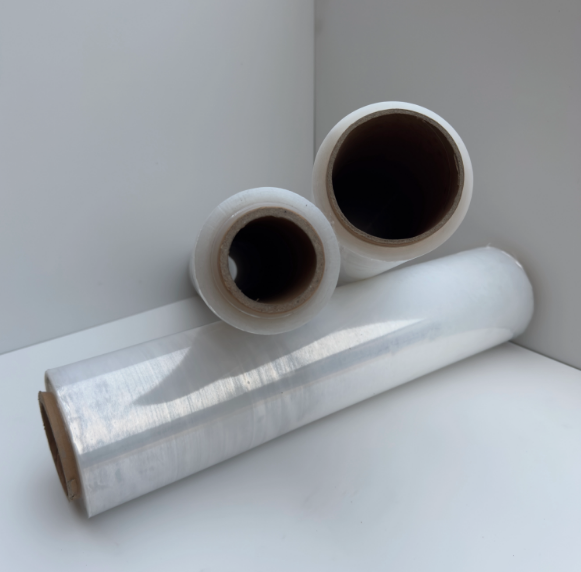
Hand film is specifically designed for the limitations of human strength. Manufacturers produce these rolls to be light enough for an operator to lift and maneuver repeatedly throughout a shift. A standard roll usually measures 1,500 feet in length and weighs between 5 and 9 pounds. The gauge (thickness) is typically lower, and the film is formulated to stretch with relatively low tension, as a human operator cannot generate the force required to stretch heavy-duty films significantly.
In contrast, machine film is engineered for high-speed, high-tension industrial equipment. These rolls are significantly larger, often holding 5,000 to 6,000 feet of material, and can weigh upwards of 40 or 50 pounds. The chemical composition allows for extreme elongation without snapping. If a human attempted to apply this film manually, they would find it physically impossible to stretch it to its working point, and the sheer weight of the roll would cause rapid fatigue.
| Feature | Hand Stretch Film | Machine Stretch Film |
|---|---|---|
| Roll Weight | 5–9 lbs (Ergonomic) | 40–50+ lbs (Heavy Duty) |
| Roll Length | 1,500 ft standard | 5,000–9,000 ft standard |
| Core Diameter | 3 inches (Standard) | 3 inches (Standard) |
| Application Method | Manual tension control | Power pre-stretch rollers |
The primary operational difference lies in control. Hand application relies entirely on operator judgment. The tension applied to the load depends on how hard the worker pulls, their grip strength, and their energy level at that specific moment. While this method offers high mobility—you can wrap a pallet anywhere in the warehouse—it is labor-intensive and inconsistent.
Machine application relies on programmable settings. A stretch film wrapping machine uses gears and rollers to pre-stretch the film to a specific percentage before it ever touches the load. Once the settings are locked in, the machine applies the exact same amount of film with the exact same tension, regardless of whether it is the first pallet of the morning or the last pallet of the night. This compatibility rule is critical: humans cannot effectively apply the tension required to utilize machine film, and machine film rolls are physically too heavy for safe manual use.
The strongest financial argument for automation lies in "stretch rate economics." This concept explains why a more expensive roll of machine film often results in a drastically lower cost per pallet than a cheaper roll of hand film.
Plastic memory and yield points are the science behind savings. When a human wraps a pallet, they are physically limited by their own strength. Even a strong operator pulling as hard as they can will typically achieve only 10% to 20% stretch. This means 1 foot of film on the roll covers roughly 1.1 feet of the pallet. You are using the film at almost a 1:1 ratio.
Machines change this equation through "Pre-Stretch" technology. The film is threaded through two powered rollers where the second roller spins faster than the first. This process elongates the film before it is applied to the load. Standard performance for modern equipment is 200% to 250% pre-stretch. In this scenario, 1 foot of film off the roll becomes 3 feet of effective wrap on the pallet. You are essentially tripling the yield of every consumable roll you purchase.
Procurement teams often look at the "Price Per Roll" and assume hand film is the budget-friendly option. This is a false economy. The metric that matters for profitability is "Price Per Pallet."
Consider the math:
If you buy a 5,000-foot roll of machine film and run it through a wrapper with 200% pre-stretch, you generate 15,000 feet of usable packaging material. To get that same 15,000 feet of coverage using hand wrap (at 0% stretch), you would need to buy ten standard 1,500-foot rolls. Even if the hand rolls are cheaper individually, the sheer volume required to do the same job makes manual wrapping significantly more expensive over a fiscal year.
Beyond yield, machine accuracy minimizes waste caused by human error. Operators who are tired or unsure about a load's stability tend to over-wrap. They might apply ten layers when five would suffice, adopting a "better safe than sorry" approach. This habit bleeds money. A machine programmed for the optimal containment force uses exactly the amount of film necessary—no more, no less.
Material savings are important, but ensuring your product arrives intact is paramount. The hidden cost of manual wrapping often appears in the form of damaged goods and rejected shipments. This is frequently due to what logistics managers call the "Friday Afternoon Syndrome."
Human performance fluctuates. A worker's wrapping quality at 8:00 AM on a Tuesday is likely robust and tight. By 4:00 PM on a Friday, after hours of physical labor, that same worker is fatigued. The tension drops, the overlap becomes inconsistent, and the bottom layers may not be secured to the pallet correctly. This variability introduces risk into your supply chain.
Automation eliminates this variable. Machines apply consistent containment force—the squeezing pressure that holds the load together—regardless of the time of day or the number of pallets wrapped previously. Every load leaves the dock with the same security profile.
When fatigue sets in, operators often succumb to the "Good Enough" syndrome. They may skip the top wrap or fail to overlap the layers by the recommended 50%. While the pallet might look secure sitting on the dock, it lacks the structural integrity to survive the vibrations of a truck ride.
A reputable stretch film manufacturer provides specifications regarding "elastic memory." This is the film's desire to return to its original state after being stretched, which creates the holding force. This property is only fully realized when the film is stretched to its designed percentage. Hand wrapping rarely activates this memory fully, leading to loose loads that shift during transit. Only machines can consistently stretch the film enough to activate its full holding power, ensuring the load remains static from your warehouse to the customer's door.
The cost of wrapping a pallet isn't just the plastic; it is the person doing the wrapping. Manual wrapping is physically demanding, slow, and hazardous. Moving to automation transforms your labor efficiency and liability profile.
Throughput is the speed at which your warehouse operates. A manual operator can typically wrap about 12 loads per hour effectively. A semi-automatic turntable machine can wrap 40 to 55 loads per hour. However, the true gain is in opportunity cost.
When a worker wraps a pallet by hand, they are 100% occupied by that task. They cannot do anything else. With a machine, the operator attaches the film, presses "Start," and walks away. During the wrap cycle, they can stage the next load, check shipping paperwork, or load a truck. This effectively doubles their productivity.
Hand wrapping is a biomechanical nightmare. It requires the operator to walk backward in a circle while bent over at the waist to secure the bottom of the pallet, then reach high to secure the top. This "bend-and-twist" motion, combined with the dizziness from walking in circles, makes hand wrapping a leading cause of warehouse repetitive strain injuries (RSI) and lumbar strain.
Workplace injuries lead to increased insurance premiums and worker compensation claims. Machines eliminate the "dizzy walk" and the need for awkward bending. By removing the physical strain, businesses reduce their liability exposure significantly.
In a tight labor market, retention is critical. Hand wrapping is widely regarded as one of the least desirable tasks in a warehouse. It is dizzying, exhausting work. By automating this low-value task, you improve morale and reduce turnover. Employees are less likely to burn out or leave for a "easier" job elsewhere if they aren't required to manually wrap dozens of pallets a day.
Not every business needs a machine immediately. There is a logical threshold where the investment makes sense. Understanding your volume is key to making the right decision.
Industry analysis generally points to a specific "tipping point."
Under 15 loads/day: If you are shipping fewer than 15 pallets daily, the labor and material costs of hand wrapping are usually manageable. The capital expense of a machine might take too long to recoup. In this stage, focusing on proper hand wrapping techniques or using pre-stretched hand film is often the most cost-effective strategy.
Over 20 loads/day: Once you cross the 20-pallet threshold, the ROI clock speeds up. At this volume, the savings in film (via pre-stretch) and labor (via automation) typically pay for a semi-automatic machine within 12 to 18 months. Beyond this period, the machine essentially generates profit through savings.
Volume isn't the only factor. The nature of your goods matters.
Stick with Hand Film if: You pack highly irregular shapes that machines can't sense properly, you have decentralized packing stations across a large facility, or your volume is seasonal and extremely low for most of the year.
Switch to Machine Film if: You require uniform load security for long-haul transport, you have high throughput requirements, or you need to comply with strict vendor packaging guidelines (such as those from big-box retailers).
For businesses hovering near the threshold but not ready for capital expenditure, "Pre-Stretched Hand Film" offers a bridge solution. These rolls are stretched at the factory and wound onto lightweight cores. They require less physical effort to apply and offer better yield than standard hand film, though they still lag behind the efficiency of a stretch film machine.
The choice between machine and hand stretch film is fundamentally a trade-off between upfront investment and operational efficiency. Hand film offers a low barrier to entry with minimal upfront costs, but it carries high long-term operational expenses due to labor intensity, material waste, and inconsistent load security. Machine film requires an initial capital investment in equipment but delivers substantial long-term savings through pre-stretch technology and labor reduction.
Smart warehouse management requires looking beyond the price tag of a single roll. The decision should be based on the Total Cost of Ownership (TCO)—a calculation that includes the cost of the film, the labor time to apply it, the cost of waste, and the potential liability of damaged goods. We recommend auditing your current "cost per pallet." If you are wrapping more than 20 loads a day by hand, you are likely bleeding money that could be saved by switching to automation.
A: No. Hand film is not designed to withstand the high tension and pre-stretch capabilities of a machine. If you attempt to use it, the film will likely snap repeatedly, causing downtime and frustration. Additionally, the cores on hand film rolls are often different sizes and may not fit the machine's carriage properly.
A: It depends on the formulation, but most machine films are "one-sided cling." The inner layer clings to the load, while the outer layer remains smooth. This prevents pallets from sticking together when they are stored tightly in trucks or racking, which can cause damage when loading or unloading.
A: While results vary based on volume, switching from hand wrapping to a machine with pre-stretch capability generally reduces material usage by 30% to 50%. When you factor in labor savings, the total cost reduction per pallet can be significant.
A: Cast film is extruded on a chill roll, resulting in a clear, quiet film that unwinds easily. Blown film is created by blowing hot resin into a bubble; it is tougher and has higher puncture resistance but is noisier to apply and hazier than cast film. Cast film is more common for general palletizing due to its clarity and quiet operation.


