
Views: 0 Author: Site Editor Publish Time: 2026-02-11 Origin: Site


Every logistics manager fears the sound of a collapsing pallet. It signifies damaged inventory, safety hazards, and rejected deliveries. Choosing the correct packaging material prevents these disasters, yet the options can be overwhelming. The primary decision usually narrows down to two manufacturing distinct styles. You must choose between the rugged durability of blown film and the cost-efficiency of cast film.
This decision is not merely about manufacturing nuances. It represents a strategic trade-off between holding power and operational speed. Selecting the wrong material leads to two expensive outcomes: load failure from weak containment or financial waste from over-packaging. This guide provides an evidence-based comparison of physical properties and cost implications. We analyze specific use cases to help you select the right stretch wrap for your warehouse operations.
Market Dominance: Cast film represents approx. 70–80% of the market due to lower costs and higher production speeds; Blown is a specialized solution for demanding loads.
Performance Profile: Blown film offers superior puncture resistance and "load memory" (snap-back); Cast film offers superior clarity, quiet application, and easier stretching.
Environmental Factor: Blown film is required for cold chain/freezer environments where cast film loses cling; Cast film is preferred for barcode scanning operations.
Cost Logic: While Cast has a lower cost-per-roll, "down-gauging" capabilities in modern films affect the true Total Cost of Ownership (TCO).
To understand performance, you must first understand the molecular structure created during production. The terms "cast" and "blown" refer to the extrusion process used to create the plastic. These processes dictate how the polymer molecules align. This alignment ultimately defines how the film behaves under tension.
Manufacturers create cast film by feeding resin into a heated barrel. The machine forces molten plastic through a flat die onto a chilled roller. This process is known as the "chill roll" method. The rapid cooling solidifies the film almost instantly.
This speed causes the polymer molecules to align linearly. The resulting structure is uniform and orderly. Consequently, cast film is incredibly clear and glossy. It unwinds quietly because the smooth surface creates little friction. However, this linear molecular alignment means the film has less multi-directional strength. It stretches easily but may tear if a sharp object punctures the web.
Blown film production is a slower, more complex operation. The resin passes through a circular die, creating a thick tube of plastic. The machine blows air into this tube, expanding it into a large bubble that rises vertically. Ambient air cools the bubble gradually as it climbs the tower.
This slow cooling allows the molecules to form an interlocked, random cross-web pattern. Think of it as a tangled net rather than parallel lines. This structure gives blown film immense strength. It is hazy and dull rather than clear. The production rates are lower than cast lines, which generally makes blown film more expensive to produce.
The molecular difference heavily influences "elastic recovery," often called memory. This is the film's ability to snap back to its original state after you stretch it. Blown film has superior memory. It constantly tries to return to its pre-stretched size, exerting a high "hugging" force on the pallet. Cast film tends to relax slightly after application. It provides adequate tension for standard loads but lacks the aggressive snap-back of blown varieties.
Warehouse managers must evaluate films based on how they interact with specific loads. We have broken down the critical performance metrics below.
| Feature | Cast Stretch Film | Blown Stretch Film |
|---|---|---|
| Clarity | High Gloss (Glass-like) | Hazy / Dull |
| Noise Level | Silent Unwind | Loud / Crackling |
| Puncture Resistance | Moderate | Superior |
| Cling Type | Two-Sided | One-Sided |
| Load Memory | Good | Excellent |
Blown film is the king of load retention. Its interlocked molecular structure provides a higher holding force. This makes it the best choice for heavy or unstable pallets that might shift during transit. If you ship heavy industrial components, blown film prevents movement.
Cast film provides sufficient retention for Type A and Type B loads. These are standard loads with uniform shapes, like stacked boxes. However, cast film is prone to some elongation over time. If a pallet sits in a warehouse for months, the cast film may loosen slightly compared to blown film.
You must distinguish between the initial puncture and the subsequent tear. Puncture resistance measures how much force is needed to breach the film. Blown film excels here. It resists sharp edges, wood splinters, and nails effectively.
Tear propagation measures how far a rip spreads once the film is breached. Historically, cast film had poor tear resistance; a small hole would "zipper" across the entire web. However, modern high-performance stretch film formulations have improved significantly. Many premium cast films now resist zippering effectively, narrowing the performance gap.
Blown film is typically manufactured with cling on only one side. This is a massive advantage for storage. It prevents pallets from sticking together, or "blocking," when you place them side-by-side in trucks or racking. The outer face is slippery, allowing pallets to slide past each other without tearing the wrap.
Cast film naturally clings to itself on both sides. This creates a very tight seal around the load. However, the two-sided cling can cause adjacent pallets to bond. If a forklift operator tries to pull one pallet out, they might drag the neighboring pallet with it, causing a safety incident.
Cast film offers high gloss and glass-like clarity. You can easily see the products underneath. This is vital for operations that rely on scanning barcodes through the wrap. However, expert insights suggest a nuance here. The high gloss can sometimes cause glare under bright warehouse lights, which might confuse sensitive scanners.
Blown film has a hazy, dull finish. It makes visual inspection more difficult. You might not be able to read small text on a box through three layers of blown film. However, the matte finish produces less glare, which can be beneficial in specific lighting conditions.
Noise pollution is a genuine concern in busy packaging facilities. Cast film comes off the roll almost silently. This makes it the preferred choice for large distribution centers with multiple wrapping stations.
Blown film is notoriously loud. It creates a harsh, crackling sound as it unwinds. This noise comes from the stronger tackifiers and the release force required to pull the film layers apart. In a small room, the sound of blown film application can be irritating to employees.
Knowing the physical properties is useful, but applying them to real-world scenarios is critical. Use this framework to decide which material suits your specific application.
If your pallets are heavy or have sharp corners, you need blown film. This includes construction materials, bricks, timber, or machinery parts. These are often "C" loads where pallet gaps exceed 3-4 inches. The film must bridge these gaps without puncturing. Blown film’s superior toughness ensures the wrap survives the journey from the dock to the customer.
For Consumer Packaged Goods (CPG), beverage distributors, and standard boxed items, cast film is the logical winner. These loads are uniform and lack sharp edges. The clarity of cast film enhances product presentation. Furthermore, high-volume environments often utilize high-speed automated wrappers. These machines require the consistent film release that cast extrusion provides.
The cold chain demands specific materials. Standard cast film tackifiers (the glue additives) often migrate or freeze in sub-zero temperatures. When this happens, the "tail" of the wrap comes loose, and the pallet unravels. Blown film maintains its cling in deep freeze environments (down to -0°F). If you are wrapping ice cream or frozen seafood, blown film is mandatory.
When humans apply the wrap, ergonomics matter. Cast film requires less force to stretch. It is easier for operators to apply manually without straining their backs. Blown film protects better, but it has high unwind tension. An operator has to pull harder to get the film off the roll. This leads to faster operator fatigue. For hand wrapping, cast is often preferred for employee comfort unless the load is extremely heavy.
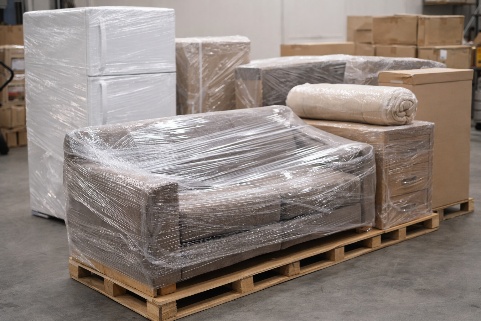
Purchasing decisions often stop at the price per roll. However, smart managers look at the Total Cost of Ownership (TCO). This includes yield, waste, and potential damage rates.
Blown film is generally more expensive to manufacture because the process is slower. Therefore, the cost per pound is higher. Cast film production lines are faster and more efficient, driving down the unit cost. Furthermore, cast film offers better yield. It stretches further with less force, allowing users to wrap more pallets per roll in standard applications.
Advancements in nanotechnology have revolutionized the cast film market. Manufacturers can now produce cast films that are incredibly thin—down to 40 or 50 gauge—while maintaining the strength of older, thicker films. This is called "down-gauging."
You can significantly improve your ROI by switching from a standard 80-gauge blown film to a high-performance 50-gauge cast film. This switch can reduce plastic usage by 20% to 30%. You pay for less plastic per pallet wrapped, lowering your packaging bill without sacrificing load stability.
Choosing the right film also reduces "neck-down." Neck-down occurs when the film narrows as you stretch it. If a 20-inch roll narrows to 15 inches when stretched, you need more revolutions to cover the pallet. High-quality cast films resist neck-down better than cheap alternatives. This ensures you use fewer revolutions, reducing both material waste and time.
Your wrapping equipment dictates which film performs best. Putting premium film on an incompatible machine is a waste of money.
Modern machine stretch film is designed to be elongated before it touches the load. Cast film is highly responsive to pre-stretch carriages. It can stretch 200% to 300% or more without breaking. This makes it ideal for power pre-stretch machines that maximize material efficiency.
Blown film can be pre-stretched, but it behaves differently. It requires higher tension settings. It is often an excellent choice for older braking-style machines that rely on friction rather than motorized rollers. If your equipment is older and lacks sophisticated tension controls, the toughness of blown film may prevent frequent film breaks.
Do not underestimate the impact of noise. Switching a quiet warehouse from cast to blown film can lead to immediate operator complaints. The loud crackle of blown film raises the ambient noise level, potentially masking safety signals like forklift horns. If you must use blown film, consider providing hearing protection or using it only in designated zones.
Sustainability is no longer optional. Both manufacturing processes now support Post-Consumer Waste (PCW) integration. Manufacturers can blend up to 30% recycled content into new rolls. However, the cast process generally handles recycled resins with better clarity consistency. Blown film with high PCW content may become even hazier and have a rougher texture.
The battle between cast and blown film does not have a single winner. It depends entirely on your specific needs. Cast film is the "workhorse" for 80% of standard logistics. It is cost-effective, clear, quiet, and perfect for automated systems. Blown film is the "specialist." You call on it for sharp, heavy, or frozen loads where failure is not an option.
To make the final decision, audit your load profile first. Check your damage records. If your damage rate is near zero, you might be over-packaging with expensive film. In this case, switching to a lighter cast film could save money. Conversely, if damages are high due to punctures, the premium price of blown film is far cheaper than the cost of rejected deliveries.
A: The noise indicates you are likely using blown stretch wrap. The loud crackling sound is caused by the separation of the layers as they unwind. Blown film uses stronger tackifiers (glue additives) and has a higher release force than cast film. If the noise is disruptive to your operations, consider switching to a cast film, which unwinds almost silently.
A: Generally, no. Standard cast film is not recommended for freezer environments. The cold temperatures cause the tackifiers in cast film to freeze and lose their stickiness. This leads to the film tail unraveling and the load becoming unstable. For cold chain applications, specifically deep freeze storage, blown film is the industry standard because it maintains cling at sub-zero temperatures.
A: No. These are two completely different packaging methods. Stretch wrap relies on elastic memory and tension to hold a load together; it is applied by pulling it tight around a pallet. Shrink wrap fits loosely around a product and is then exposed to heat. The heat causes the plastic to shrink and conform tightly to the item. Shrink wrap is typically used for retail packaging, while stretch wrap is used for logistics.
A: Cast film typically has two-sided cling, meaning both the inner and outer surfaces are sticky. This creates a tight seal but can cause pallets to stick together (block) on a truck. Blown film usually features one-sided cling. The inner side sticks to the load, while the outer side remains slick. This allows pallets to slide against each other without tearing the wrap during loading and unloading.
A: Both cast and blown films are typically made from Linear Low-Density Polyethylene (LLDPE), which is a Category 4 recyclable plastic. Both are fully recyclable. However, in practice, recycling streams can be contaminated by paper labels or other debris. While the chemical composition is similar, ensure you remove non-plastic contaminants before sending either film type to a recycling facility.


